Showing posts with label Andy Warhol. Show all posts

Wednesday, October 30, 2013

Lou Reed, Vocalist: An Appreciation.


If you were to chart rock and roll singing with Elvis (ideal, majestic) at one end and Johnny Rotten (depraved, sinister) at the other, Lou Reed would land right in the middle at sea-level—neither good nor bad, but rather the point on the zero axis at which things went from positive to negative.

It is a pause, a blank, a nothing.

While Reed isn't himself a punk singer in the broken, nihilistic sense, he sets the stage for it, sends it on its course. He is the vocal equivalent of the first circle of Dante's hell, where Dante meets Virgil; a sort of gray underworld where everyone who lived before the time of Christ inhabit because they never knew the light of hope. Unlike Dante's other circles, it wasn't filled with suffering and agony because none of the people necessarily knew they were in hell, it was more like they were living in a black-and-white world, unaware that a color one was even possible.

Bob Dylan set the stage for such a style by bringing Woody Guthrie's dry, earnest realism to modern folk and then rock and roll, but at the end of the day, Dylan had a beautiful, expressive voice—a chameleon-like array of disguises that belied his young age with first a world-weariness ("A Hard Rain's A-Gonna Fall"), and then a bemused detachment ("Like a Rolling Stone"), before settling into a strange croon ("Lay Lady Lay") by the decade's close. For, at the end of the day, Dylan was ultimately still a singer.

Lou Reed was closer to a talker. He upped Dylan's ante by taking the deadpan and using it almost aggressively in the ultimate street-hustler's cool, a lie that believes itself. Vicious. You hit me with a flower.

Such a pose worked because Reed's lyrics were often as deadpan as his vocals—deceptively simple things that added up to a sum far greater than its parts. Some have compared it to Hemingway, but I suspect that's more to highlight the hidden romanticism in modernism. T.S. Eliot might be a truer comparison—Lou Reed could indeed show you fear in a handful of dust.

It was the odd, precise details that made Reed's best songs cut like razorblades—the street names and the number of flights up to reach the dealer in "I'm Waiting For My Man," the Thursday's rags and blackened shroud worn at "All Tomorrow's Parties," the way the junkie's neck veins feel from "Heroin," the wine in the morning of "I'm Beginning To See The Light," the sangria in the park of "Perfect Day"—they felt more like roadmaps that you too could follow as opposed to the evocative, if bleak, poetry they truly were.

Who else could start a love song with the words "Sometimes I feel so happy / Sometimes I feel so sad" and pull it off? The same person who can then sing "She said, 'money is like us in time / It lies but can't stand up / Down for you is up'," three verses later with the same plain sense of conviction—or lack thereof (see: "Pale Blue Eyes").

Throw in the array of characters who walked in, out, and through the songs in a manner that today feels pitched between Springsteen and Faulkner—Sweet Jane, Sister Ray, Candy, Lisa, Stephanie, Little Joe, Jackie, Daisy Mae and Biff, Harry, the Countess of Hong Kong, and Jenny, whose life was saved by rock and roll—and you have an endless sprawl of people who litter the music like the shards of a broken mirror smashed upon the street.

The one-two punch of Reed's flat vocals and exacting lyrics resulted in a sound that demanded to be taken completely literally; in fact, Lou Reed may just be rock and roll's first and greatest realist. Vocally, his only competition is Leonard Cohen (who Reed beat by two years) and lyrically his only competition is Iggy Pop (whose career is nearly unthinkable without the Velvet Underground). More than anyone else, Reed's songs seemed to grab you by the collar and look you in the eye. They felt real.

It would take the explosion (and implosion) of punk and its aftermath to push this style over the edge, as postmodernists like Joey Ramone turned up the irony, Patti Smith turned up the poetry, and Johnny Rotten turned up the anarchy. But Reed's deadpan style was the formula with which all of these were possible; he was the water that you had to add.

But for Reed, whose most influential period came out of a desire to write simple two-chord songs that anyone could figure out after hearing once, perhaps this was the plan all along. "Andy Warhol told me that we were doing the same thing with music he was doing with painting and movies and writing—i.e., not kidding around," Reed once explained about the Velvet Underground's initial partnership with Andy Warhol. "To my mind nobody in music was doing anything that even approximated the real thing, with the exception of us. We were doing a specific thing that was very, very real. It wasn't slick or a lie in any conceivable way, which was the only way we could work with him. Because the very first thing I liked about Andy was that he was very real."

For Warhol, it may have come down to beauty. "The more you look at the same exact thing," Warhol once said, "the more the meaning goes away, and the better and emptier you feel." But Reed seemed to come at it from the opposite side—he took the blankness and found meaning, no matter how dry, strange, or harsh it seemed.

Yes I am mother nature's son
And I'm the only one
I do what I want and I want what I see
Huh, could only happen to me

I'm...so free

I'm...so free

One of the first anthems of the New York City punk scene the Velvet Underground helped to midwife was Richard Hell's "Blank Generation." Although many have interpreted the song as a celebration of nihilism, Hell always disagreed. For him, blank was just that—a blank—something that could be filled in with anything.

In other words, it was freedom.

This is what Reed seemed to be suggesting with his voice. Being at zero isn't the absence of everything, it's the possibility of anything. Thus, even though Reed's styles have ranged over the years from rock to punk to glam to pop to doo-wop to heavy metal, he always sounds like Lou Reed.

In doing so, he forces blankness to stare back at itself until it becomes something else entirely—art.

Sunday, October 27, 2013

If You Choose, Try To Lose: Last Thoughts On Lou Reed, 1942-2013.

"Music's never loud enough. You should stick your head in a speaker. Louder, louder, louder. Do it, Frankie, do it, oh, how. Oh do it, do it."
— Lou Reed


Lou Reed marks the point at which modern popular music becomes postmodern popular music. His band, The Velvet Underground, didn't so much influence rock as they did rip it up and remake it into their own image, a fragmented sprawl of a thing that we still feel the shockwaves of today.

Perhaps in part because of this Reed's life seemed to have gone by like a series of epic moments, broken fragments that in telling part of the story, told more than a full picture could even begin to. Thinking upon his life, it's these pieces that come to mind.
  • The way his parents used electroshock therapy on him in as a teenager in the late '50s, in an attempt to cure him of his homosexuality.
  • As a demented songwriter at the D-Level Brill Building of Pickwick Records, where he wrote "The Ostrich," a strange send-up of the current dance-craze songs that told listeners to put their head on the ground and step on it.
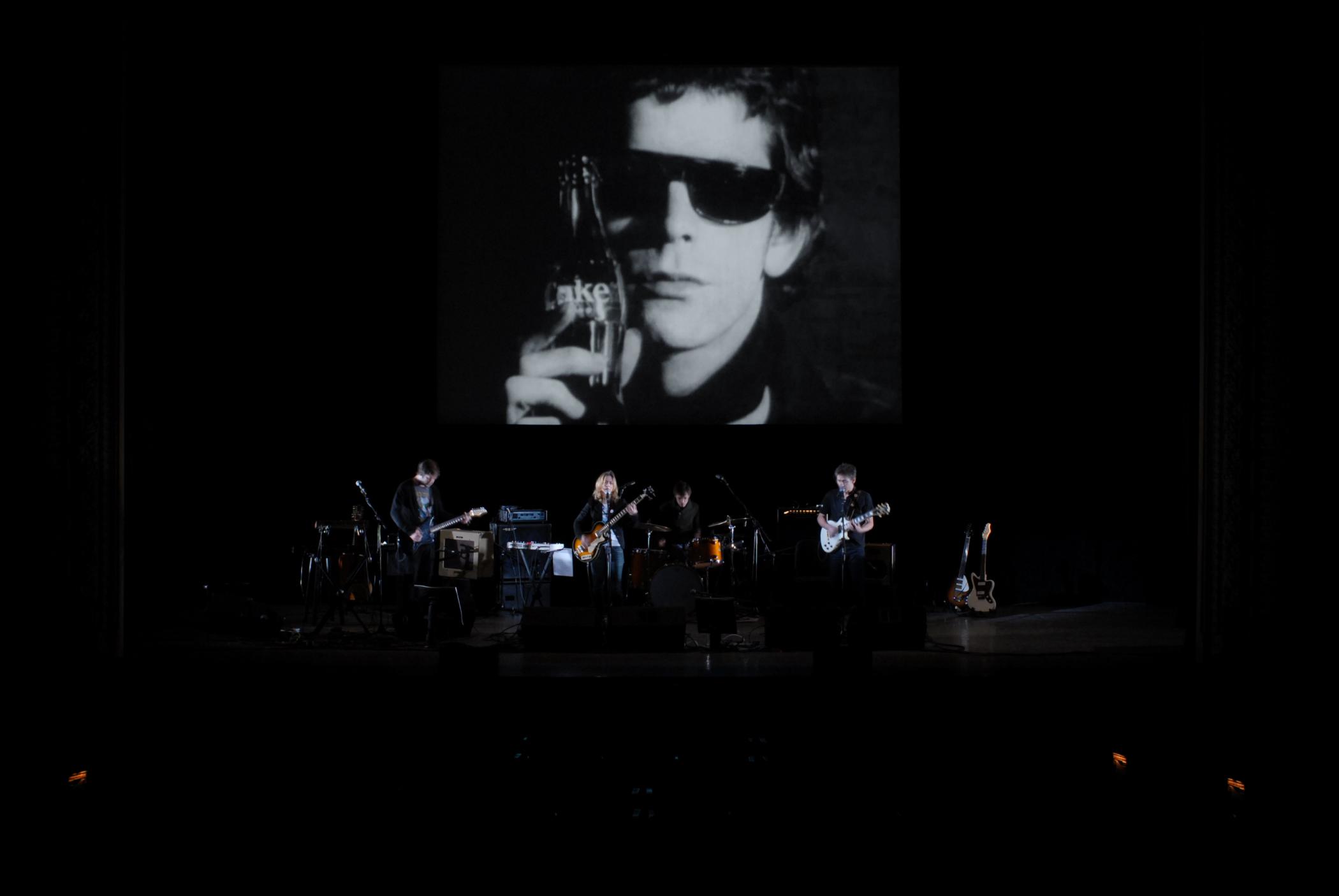
  • Playing "The Black Angel's Death Song" one too many times at the Cafe Bizarre, which allowed the Velvets to begin their partnership with Andy Warhol the next day.
  • Performing at Warhol's Up-Tight (later retitled The Exploding Plastic Inevitable) in all black, as his ear-piercing guitar was the eye of the storm, films and light shows projected over him, whip dancers and videographers all around, everything grooving to his savage two-chord exercises in drugs, paranoia, and fear—of which, oddly, no full document remains.
  • His ill-fated affair with Nico, who legend has it walked into Warhol's Factory after Reed spurned her and announced, "I can no longer make love to Jews."
  • Making one last earnest jab at commercial success with the Velvets' last album, which in songs like "Sweet Jane" and Rock And Roll" did make the classic rock rotation—it just took 20 years to get there.
  • Releasing his signature "Walk On The Wild Side"—about transgender hitchhiking and hard drugs (among other things), and is the song by which he's probably still best known today—which an authority no less than Greil Marcus has termed the strangest song to ever hit the Top 20 (it made #16 in 1973, and at one point in the mid-'90s was the 499th best-selling song of all-time).
  • Releasing his two-record Metal Machine Music, the greatest "fuck-you" in popular music history—it's four album sides of clanging machines—which an authority no less than Lester Bangs argued (rather convincingly) was the greatest album of all-time, period.
  • Showing his love for New York doo-wop by inducting Dion into the Rock and Roll Hall of Fame in the late 1980s.
  • Joining his former Velvets bandmates in the 1990s to launch one of the most unexpected reunion tours in rock history.
  • And finally, collaborating with Metallica on the 2011 album Lulu, which was either brilliant or a piece of shit depending on who you asked. Even at the end, Reed managed to be divisive as always.
But let's go back to the Cafe Bizarre, in the Christmas season of 1965, when the Velvets, newly discovered by Warhol, broke their engagement by playing "The Black Angel's Death Song." They would later play it at Warhol's pioneering multimedia shows and record it on their legendary first album, The Velvet Underground & Nico.

It is, to my ears, their masterpiece.


"I'm Waiting For My Man" may have helped bring punk to rock, "Venus In Furs" may have introduced hard sex to rock, and "Heroin" may have brought hard drugs to rock, but "The Black Angel's Death Song" stands apart from everything else on the album—as well as any song that they or any other rock band would record.

Built around John Cale's careening, screeching electric viola, Reed spits out his words his words in the second person, commanding you the listener to heed what is described in the song.

The myriad choices of his fate set themselves on a plate for him to choose 
What had he to lose

Not a ghost-bloodied country all covered with sleep
Where the black angel did weep not an old city street in the east
Gone to choose

Over the course of eerie, hypnotic song, there are cuts from long-splintered knifes, the ice skates-scaping chunks of bells, and cut mouth bleeding razors, before giving the most evocative description of wintertime New York City I've ever heard: "So you fly / To the cozy brown snow of the East."

Over and over, the singer tells you to choose, but each verse leads you to the bowels of a rat, terror-reducing shame, and stone glances. Like the America that we know, it's a land of choice and opportunity—only here, every choice is wrong, if it is even a choice at all; it is as though you are allowed to pick between a half dozen doors, only to find each one has a brick wall behind it. Its music is as warm and catchy as Stravinsky's "The Rites of Spring," its lyrics are as nursery-rhyme sweet as Eliot's "The Wasteland." It is a song that doesn't just play for the listener, but confronts them, terrifies them, and tears them down, like a highlights reel from Dante's vacation home movies of hell.

There is a long-forgotten book that came out in 1993 called The Death of Rock 'n' Roll by Jeff Pike, in which he examined every side of death in rock—not just those who died, but songs about death, and the death of rock and roll as a life cycle itself, every decade or so. Larger-than-life morbid performers that seemed to cheat death, confront death, or somehow coexist with death—Robert Johnson, Jerry Lee Lewis, Elvis Presley, Leonard Cohen, and others—got their own small chapters. Among these was Lou Reed. Pike used the Reed section to argue that Reed was the rock and roll equivalent to Ernest Hemingway—a brilliant writer who spoke in short simple statements in short simple words that begged to be taken literally.

It planted the seed in my mind of Lou Reed's place among the American tradition of the deadpan mask in popular recorded music—perhaps first best heard in Bert Williams, but then down through Woody Guthrie's unfazed story-telling, Dylan's dry gallows humor, and finally Reed's monosyllabic croak. Reed seemed to out-Dylan Dylan if there was such a thing, so that it almost parodied rock singing by over-emphasizing the talking (and setting the stage for The Ramones, who would do just that).

But where Pike saw in Hemingway an ultimately tragic hero, he viewed Reed as a closet romantic, and thus predicted that he would be spared Hemingway's fate. That seems to be the case here.

For everything that has been said, unsaid, or completely made up about or by Lou Reed, he always prided himself from early on for being "real." It certainly explains how he maintained such a long career, but it also explains how my friend Vin described meeting him at a book signing as though he was meeting a long-lost uncle. I asked Vin what he said to him, and Vin relayed it in a rasped low tone, to capture the postmodern rock statesman's voice. "Hey man. What's your name? Vin? What do you play, man?"

If you chose, try to lose, for the loss of remain come and start, start the game... 
Chose to choose. 
Choose to lose. 
Choose to go.

Friday, October 29, 2010

Andy Warhol: Genius

I believe that Andy Warhol was the last true American genius. He takes his place among the others who saw America in a new and different way that was ultimately visionary and prophetic. These people are few in number but stretch back far in terms of tradition: Benjamin Franklin, George Washington, Thomas Jefferson, Abraham Lincoln, Walt Whitman, Emily Dickinson, Louis Armstrong, and Martin Luther King, Jr., to name some of who I consider the key members of this elite group.

Andy Warhol takes his place alongside these other people because, like them, he had a complete and unique vision of America -- and it's one that proves truer with every passing year. It is, in a word, Pop. Long before the advent of reality television or up-to-the-second Twitter updates, Warhol envisioned a country that was paradoxically fueled by its emptiness, taking the lowest byproducts of modern mass consumer culture -- advertising imagery and endless reproductions of glamorous pop culture stars -- and elevated it to the level of high art. It was a land in which image is everything, fame is fleeting, and surface is depth. In other words, America as we know it today.

One only needs to walk into a supermarket or turn on the television to see the affects of this. Often when I go by checkout lines or newsstands, I'll think about what a shame it is that Warhol did not live to see what I can see. All over are bright magazines -- celebrity rags like Us, Life & Style, OK!, and Star -- promising up-to-the-minute "news" about the current "It" children of Hollywood, each of which are so overlapping in style and stories that they all just seem to blend into one big magazine with repeating pictures and printed on cheap paper.

Like the New York Dolls reached for a punk audience they knew must be there, Warhol seemed to sense this phenomenon, launching his own celebrity magazine, Interview, to celebrate celebrity with its trademark star-on-star interviews. Last time I checked, Interview was still going along, but it's usually kept with the "lifestyle" magazines as opposed to the celebrity weeklies. It is, for lack of a better word, quaint -- an oversized glossy magazine featuring famous stars interviewed by slightly less famous stars, one man's vision of how the national obsession with celebrity would play out in a future in which everyone becomes famous for 15 minutes.

But there is another thing that separates Interview from the celebrity weeklies: Interview usually focuses on established, glamorous stars who most can agree have some amount of talent, while the weeklies focus on the current pick-of-the-month wild child or self-destructive media whore who often does not seem to have any real talent. In fact, many of them come from reality television -- the other great media in which Warhol's vision plays out every day -- as quasi-famous people appear on disposable reality television shows (some people can remember the members of the first Real World cast, American Idol winner, and Bachelor contestant, but how many can name the second, third, or seventh?) By applying the lowest-common denominator of fame to the reality television participant (that is, that they appeared on television), the celebrity magazine and television show depend upon each other, creating an endless cycle of hype and validation that is most clearly seen on online blogs, where the magazine and television essentially become one instantly and constantly-updated beast.

The most important television shows in America today are its reality shows. I've come to believe that all of America can be measured on a scale with MTV's Jersey Shore at one end and A&E's Hoarders on the other -- young and old, beautiful and ugly, public and private, outdoor and indoor, mindless and probing, comic and tragic, naked and mad, beautiful and damned, muscular and weak, sexy and sterile, alive and dead. They are the benchmarks because they each take the hallmark of American's global identity -- mindless consumerism -- to its two logical extremes: the young and superficial scene-maker whose world proudly revolves around gym, tanning and laundry and divides their time between the beach house, the beaches, and the dance club, and the older and reclusive depressive who has spent decades literally buying everything they can, beyond the point of logic, safety, or sanitation, often in a house that is falling apart all around them. Both add up to the same effect: They are both trainwrecks -- try as you may, you cannot look away.

But perhaps even more importantly, they both are examples of one of Warhol's central maxims that surface could be depth. Describing the desired effect of his groundbreaking multimedia Up-Tight show from 1966, where the Velvet Underground played savage, avant-garde rock and roll at a deafening volume, over which Warhol would project his mind-numbingly boring films of people sleeping or sunlight slowly changing over a building, Warhol explained that "The more you look at the exact same thing, the more the meaning goes away, and the better and emptier you feel." Emptiness, he seemed to be saying, was not a sin, it was a virtue. And so the mundane became profound, and the trash became beauty.

Driving Warhol's vision was a unification of opposites similar to his emptiness-as-virtue philosophy: The notion that the very lowest culture can be the flipside of the very highest of culture. He first did this with his early Pop paintings of cartoon characters and retail catalogue imagery, which he saw through his signature silkscreen prints of celebrities, wanna-bes, and cultural icons, and even on such late-period activity like when he appeared on an episode of The Love Boat. This paradox has infiltrated virtually every part of our popular culture, from films like Pulp Fiction to television shows like Jersey Shore, musicals like Rent, and virtually the entire sweep of post-modern rock and roll music, which Warhol himself helped to ignite with the Velvet Underground (it would peak a decade later with the Sex Pistols).

But for me, nothing sums up the picture better than the whole "vintage T-shirt" craze of the late '90s and early '00s -- once the first wave of hipsters bought up the best ones in all the thrift stores, places like Urban Outfitters started making new shirts that looked vintage, and the younger hipsters didn't really care about the clothes' levels of authenticity; for them, looks were enough. Every time I walk by a sales rack in a fine clothing store with T-shirts that are made to look aged or jeans that are manufactured with holes, I think of Warhol and wonder what he would say about this.

My guess is he would have nothing to say and so he would say nothing.