Sunday, November 25, 2012

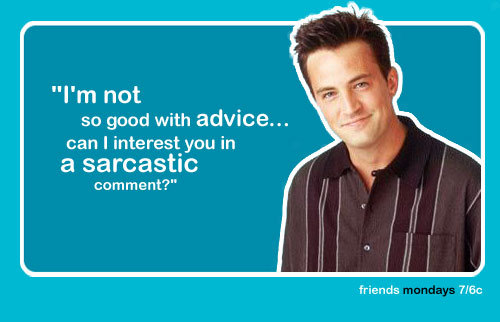
The Top 5 Ready-To-Steal "Friends" Lines.


A few months ago, my friend Margaret posted a confession on Facebook: "I stole a joke from 'Friends' & passed it off as my own."

It was a perfect miniature commentary on the blurry lines between (post?) modern American humor & culture. To wit: Despite of—no wait, make that because of—its overwhelming mainstream popularity, Friends is the antithesis of a hip show. Contemporary non-hits like Arrested Development are the stuff the hip kids get misty-eyed over; the few big-hit shows that become cool only do so in retrospect, usually through nostalgia (see: The Cosby Show).

All of which overlooks a simple fact: Friends is a very funny show. As a result, it exists in a weird pop cultural loophole: It's chockfull of great jokes that thousands of "mainstream" folks have seen, but a disproportionately low number of "hipsters" (Malcolm Gladwell might say "influencers") know. The result is an entire demographic unwittingly hungry for an avalanche of readymade product.

But where to begin? Friends lasted 10 seasons is upwards of $300 for the whole series. Well don't worry, American Wolf has got yer back. Some jokes are more universal than others; for better or for worse, I've parsed through all of the shows to compile a Top 5 shortlist of my fav instantly-ready Friends jokes that can be applied to nearly any occasion.

Oh yeah, & the first is the one that Margaret had stolen.

1. Chandler: "Oh, I think this is the episode of Three's Company where there's some kind of misunderstanding."

Mark Twain famously wrote that American humor is so deadpan that when an American tells a joke, you don't realize it's a joke until after its over. In this regard, Chandler falls somewhere between a punchier Jack Benny & a less-surreal Mitch Hedberg as a master of deadpan. This is one of his finest—& easiest to lift—jokes, because its utility is staggering. When I first read Margaret's post, this was the first joke I thought of, in part because I had stolen it myself earlier in the week when discussing The Avengers movie: "My favorite part is when the one guy fights the other guy." One friend responded with confusion: "Isn't that like, the whole movie?" Exactly.

2. Phoebe: "Did you ever see An Officer and a Gentleman?" Rachel: "Yeah!" Phoebe: "Well, he's kinda like the guy I went to see that with."

After Chandler, Phoebe has the most amount of clutch lines, only the majority of them are not universal. But this one's got the perfect setup of a commonplace expectation that delivers an odd punch you don't see coming, as well as a transferability that makes it easy to use, in places far beyond love. Example: Someone describes a brave friend. You: "I know what you mean. Did you see Saving Private Ryan? He's kind of like the guy I went to see that with." & in one instant, the familiar becomes the random, & the pertinent becomes useless.

3. Julie: "We've gotta get some sleep." Ross: "Yeah, it's really 6:00 tomorrow night our time."
Chandler: "Well, listen, don't tell us what's gonna happen though, 'cause I like to be surprised."

This is probably my very favorite line—it's not nearly as universal as the rest, but when you can work it in (usually when people are describing jet-lag), you'll sound like the cleverest guy in the room. You can also scale it down to a more-universal-yet-less-brilliant-remark with anything that has an obvious conclusion. Example: I recently posted on Twitter, "I can't wait to see the new Lincoln movie, I just hope nobody gives away the ending before I do." Wah-wah.

4. Chandler: "You're right, I have no excuses! I was totally over the line." Joey: "Over the line? You — you're — you're so far past the line, that you — you can't even see the line! The line is a dot to you!"

This is my least favorite of the 5, but still included it to reach 5 (damn you, human fingers!), because I still do use it a lot. I often drop the last part about the line being a dot & stick with the more conventional surrealism of placing a cliched metaphor as the center of a conversation, only to arbitrarily abandon it to make a point. Example: "I am so over you, I can't even see you from where I am." Again, not exactly genius, but a decent thing to say if you wanna throw an unexpected twist into what may otherwise be a blank tirade.

5. Monica: "Hypothetically, why don't I have a baby by the time I'm 40?" Chandler: "Oh dear God — this parachute is a backpack!"

& when all else fails, you have this. This is from the early episode where Ross's son is born, & Chandler offers to have a baby with Monica if she doesn't have one by the time she's 40. This, of course, leads to the above dialogue, topped by Chandler falling backwards out of his chair as he grasps furiously at his invisible backpack. So the next time you irrevocably put your foot in your mouth (ideally while sitting down), you know what to do.

Saturday, November 17, 2012

The Top 5 Most Bizarre Moments of the 2012 Campaign.


It's only been 10 days, but the 2012 election already feels like eons ago. The perhaps-likely win for Obama has become now-obvious, while Romney's disappearance from the mainstream Republican dialogue has been carried out with a velocity that is almost staggering.

But even as the surreal settles into the ordinary, the campaign still comes back to me in bits like a deep, long dream that stalks waking life. Like a dream, it was very weird — far more so than any other election I can remember.

Perhaps this could only be expected from the setup. On one side, you had Barack Obama, champion of all things hope & change, now trying to show that the hope had begun to deliver & that we could not risk change right now, despite the nation's economic woes. On the other side, you had Mitt Romney, a big-business Wall Street tycoon who was the exact person who was vilified in the financial crisis in the first place. Throw into the mix that Romney's signature achievement as governor, Massachusetts' universal healthcare, was the direct template for Obama's signature achievement as president, national universal healthcare, which put Romney in the position of arguing against his own achievement while Obama praised it, & you have a very strange predicament indeed.

Which in turn was only the backdrop for a non-stop parade of weirdness:

5. Three Debates in Three Phrases


Ever since MTV first reared its beautiful, frenetically-edited head, the news story has been morphing into the soundbite. This election took things one step further, turning the soundbite into a phrase that "summarized" (more like overshadowed) the 90 minutes of debating. The first, "Big Bird," was supposed to show Romney's small-government credentials but instead found him being sensationalistic (the average American pays $1.35 a year for PBS) & out-of-touch (Elmo is the new Big Bird!). The second, "Binders Full of Women," was supposed to be a passing phrase in a clearly-rehearsed story to prove Romney's cred with women, but instead stuck out like a sore thumb & succinctly summarized everything that made Romney oblivious to the very social issues he was trying to master. The third, "Bayonets & Horses" was the only pre-planned "zinger" that landed in the debates, & was Obama's sole debate catchphrase, used to show the anachronism that was Romney's vision of national defense. & with this, the evolution was complete. Soundbite, meet bit-bite.

4. Romney Proves Unqualified To Be a UK Tourist.


It shoulda been the most open-&-shut foreign policy trip either. Mitt Romney, savior of the 2004 Olympics (an accomplishment even most Democrats gave him), was going to visit the London 2012 Olympics, held in our strongest international ally & led by fellow conservative David Cameron. Instead, Romney gave an interview on the eve of the trip expressing "disconcerting" efforts made by England that implied a lack of preparation. The result was the worst American tour of England since Jerry Lee Lewis. Romney struggled to find his footing regarding the Olympics, called diplomats by the wrong title, & told the press about meetings that were supposed to be confidential. As the gaffes followed him to his scheduled stops of Israel & Poland, so too did the always-perfect tag from the Twitterverse used to document them: #Romneyshambles.

3. Obama Sleepwalks Through the First Debate.


A perfect storm of careless statements, international stupidity, & staffing blunders had taken hold of Romney's campaign by the time he walked onstage to meet the president in the first debate. Pundits on both sides agreed that if Obama could "win" the first debate, the election would be all but over for Romney. Instead, Obama choked. What everyone forgot was that Obama was never a great debater — Hillary won most of their primary square-offs in 2008 — & Romney had sharpened his skills in the two dozen or so Republican primary debates. With the assist of non-moderator Lehrer, Romney was able to bully & bluff his way through, keeping an upper-hand on the conversation in a strange mix of curt rudeness & blatant lies. For me, though, the most head-shaking-at-a-trainwreck moments for Obama came at the beginning & end: First, when he opened with a maudlin 20th Anniversary message to his wife & began his closing remarks by saying, "Four years ago, I said I am not a perfect man & I would not be a perfect president." WHAT?! Or, he coulda added, a perfect debater.

2. Romney Rejects 47% of All Americans.


There have been blunders & there have been blunders, but there has never been anything quite like Romney's infamous "47%" comment. Secretly filmed at a closed-door campaign fundraiser, the video leaked just prior to the first debate & threatened to take his entire campaign off-course. In it, he derided 47% of the population to be victims "who are dependent on the government" & believe the government has to care for them in an act of willful laziness. These are the "people who will vote for the president no matter what," Romney explained, failing to realize that the states with the largest-amount of government aid programs are in solid-Red states like Alabama & Mississippi. But what happened next made things even weirder. Forced to answer to the video, Romney held an awkward press conference in which he granted that his words were inartfully stated, but essentially true. So the man looking to lead the country secretly writes off almost half of its population & then publicly stands by this assessment. Romney didn't plan to reverse this until the first debate, when much to his shock (& everybody else's) Obama did not bring it up. It's too bad he didn't because, based on the tepid explanation Romney gave to Fox News later that night, it woulda landed a much-needed point in the president's favor.

1. Clint Eastwood Talks to an Empty Chair.


National icon Clint Eastwood gives a high-profile endorsement of Romney & is invited to speak at the Republican National Convention after making a great impromptu speech for Romney on tour. What could go wrong? Well, Eastwood could request a chair. & the rest is...history? Said Eastwood later: "If somebody's dumb enough to ask me to go to a political convention & say something, they're gonna have to take what they get." & after watching some 12 minutes of his unscripted surrealism, this may just be the only 100% true statement to come out of the 2012 campaign.

Sunday, November 11, 2012

By The People, Or: The OTHER Reason Why I Thought Barack Obama Was Going to Get Re-Elected All Along.

I realized after completing my last post about why I always thought Obama was going to win the 2012 election, I left out the one reason that had most inspired me to write the article in the first place, probably because it was the most partisan:

Barack Obama won the election because a Republican has not fairly won an election since George H.W. Bush was elected in 1988 — in other words, in the last 5 elections, the Democrats were or should've been the true winners.

Clinton's wins in 1992 & 1996 along with Obama's win in 2008 are the obvious ones. & everybody knows that in 2000, Gore got the most number of votes, but lost it in a perfect storm of Fox News, political corruption, & (most disturbingly) the Supreme Court's Gore v. Bush decision. (Which, if you don't think it's possible for something to be compelling that's written in legalese, check out Justice Stevens' masterful dissent, which concludes that the real losers are not Al Gore or the Democrats, but the people of the United States.)

Bush's "loss" to Kerry in 2004 is the kicker, & the one that'll make most conservatives roll their eyes & think you're a joke. To all the haters (as well as all the believers), I refer you to one place, which is one of the most overlooked piece of journalism of the last decade: Robert F. Kennedy Jr.'s "Was the 2004 Election Stolen?" from the June 1 issue of Rolling Stone, which has been reproduced on the progressive website Common Dreams & can be found here.

The 2004 election was a bitter one, in some ways just as much as 2000. But ultimately, in both cases, it seemed as though the "true" winners, Gore & Kerry, didn't really want it so much after all, & in some ways this was the hardest pill to swallow of them all. After a prolonged fight to election day, it was as though neither one had any fight left in him. If Gore hadn't dismissed all of the people contesting their votes (or lack thereof) in his waning days as President of the Senate, or if Kerry had shown the muscle he failed to in the swift-boat controversy, we might be looking at a very different chain of events.

Now, in the end, it was worth the crushing defeat of Kerry (& perhaps even Gore too) if that's what it took for us to get to Obama. With Obama in 2008, the Democrats finally had a candidate strong enough to beat the Republicans, no questions asked. & with Obama in 2012, the Democrats finally had a candidate who could campaign just as strongly as the Republicans, pulling tricks right out of their handbook: Namely, defining Romney before Romney could define himself through his tenure at Bain (this year's swift-boat, if you will) & capitalizing on the "47%" video (this year's "I voted for the war before I voted against it"), which helped to keep an upper-hand on the news-cycle.

But most importantly, in 2012 the Democrats were able to learn from their previous trials & tribulations & turn them around into a stunning mandate. Voter suppression & corruption at the polls were no match for an electorate that was diverse & well-informed. The Democrats were finally able to tap into the base they always knew was out there, & deliver on it honestly & fairly.

&, as icing on the cake, an exasperated Karl Rove on Fox News began accusing the Democrats of rigging Ohio, even after the channel's own people had called the state for Obama.

Pot, meet kettle.

Wednesday, November 7, 2012

Obama 2012: Second Terms of Endearment.

It's often said that the eskimos have over 100 words for snow. After this election season, I feel that pragmatic liberals such as myself probably have 100 words for "cautiously optimistic." I think I may have used that phrase at least as much as "please" & "thank you" & definitely more than second-stringers like "happy birthday," "let's watch TV," or "dude, this makes James A. Garfield look like Calvin Coolidge."

Suffice to say that after the defeat of John Kerry's so-called "loss" in 2004, I never again would take up any of that "when we WILL win" junk that made Bob Dole sound like the scrappy old white guy that he was in the '96 election. (& no one need be reminded that Bob Dole lost too.)

But now that the dust has settled & the race has been decided by everyone except Karl Rove's superego (pun intended), it is safe for me to finally unveil what I was REALLY thinking (very loudly) every time I spoke those two hollow words: cautiously optimistic.

Thus, I bullishly call my reasoning:

Why I Thought Barack Obama Was Going to Get Re-Elected All Along.

1. Party stalwarts almost always beat compromised choices. Whenever it comes down to somebody that one party is genuinely behind — think Reagan in 1984 or Bush in 2004 or Obama in 2008 — vs. a compromised choice — think Mondale in 1984 or Kerry in 2004 or McCain in 2008 — it usually comes down on the side of party favorite. This only makes sense. Pundits can sit around & rationalize all day about why their candidate could/would/should/will win (& Fox News certainly did that with Mitt Romney), but the fact is that at the end of the day, someone who's a true party consensus leader will turn out the base. It always feels better to vote FOR somebody than AGAINST somebody else, which in this case worked to Obama's advantage.

2. Barack Obama is the greatest campaigner of his generation, if not of all-time. Love him or hate him, Barack Obama ran what may have been the finest political campaign in 2008. & I study this stuff. I imagine the only people who could give him a run for his money would be JFK in '60, Reagan in '80, & Clinton in '92, but that's about it. So the Republicans weren't just going up against a decent candidate — like, say, an LBJ or a Harry Truman. They were going up against THE BEST. I think a lot of people really underestimated this fact. & indeed, outside of one major folly — that lackluster, if not utterly bizarre first debate performance — Obama ran a campaign that was nearly has smooth as the one from four years earlier. Meanwhile, Romney's campaign was a ramshackle mess, with gaffes & miscalculations running ramped, outside of that week or so following that first debate. Romney would've ran the lesser campaign against any decent competitor, but going up against Obama made him look downright amateur.

3. The media built the election up into a horserace that it never truly was. Again, I first learned my lesson in 2004. After Kerry won the first debate, it was then decided that Bush won the second debate, & that the third was — surprise, surprise — a "draw." I later read an interview with John Kerry in which he said he thought he had won all three debates. I had to agree. But biases are biases. At any rate, after the first debate, the usually unflappable David Gergen on CNN said, "Now we have a horserace," as though he had been waiting for the exact right moment to use that phrase. Meanwhile, the Romney campaign sent out emails proclaiming that victory was in sight. After the first debate, Romney was propped up as the neck-in-neck contender, even though his first debate "surge" was clearly dissipating after about a week or so. As one pollster I read commented, if this was truly neck-in-neck, Romney would be coming out on top just as often as Obama, yet Obama almost always maintained a (however slight) upper-hand. Even more to the point, Romney was never really up in Ohio, without which there was practically no way in which he could win the electoral map. & as Obama proved last night when he won Colorado, he had enough wiggle room to win the electoral map WITHOUT Ohio, Florida, OR Virginia. Which itself is rather staggering. The short version is, nobody stays glued to a campaign when it looks like a definite landslide. & first & foremost, our media is driven by ratings & print sales.

4. Polls can be manipulated, but ethnic demographics cannot. One of my favorite jokes of this election was the SNL Weekend Update in which Seth Meyers was reporting Romney's stubborn supposed lead in the Gallup poll. "That's right," Meyers said, "Out of all of the people who still have landlines & answer the phone when it's an unrecognized number, Romney is winning." It was a telling observation. So much was written about polls & how they are manipulated (or fabricated) by one side or the other, but often the "mainstream" polls were getting it wrong by under-sampling the African-American & Latino vote. Obama won the former at his taken-for-granted-but-still-rather-amazing ~90% or so, but just as important was the fact he won the Latino vote at 70%. The 2012 election marks the first time that Latinos broke into the demographic double-digits, comprising a full 10% of the electorate. (& everyone knows it's only gonna go up from here.) By championing programs like the Dream Act — & not having to pander to his base about immigration law that is about as up-to-date as a spaghetti western — Obama held the distinct advantage over Romney. That sound you hear is all Republicans scratching their heads trying to figure out how to better embrace the Latino voter while still not betraying their party base, or as I like to call it, 1952.

5. History is on Barack Obama's side. It's conventional wisdom among American History junkies that all of the great presidents were reelected for a second term: Washington, Jefferson, Jackson, Lincoln, Teddy Roosevelt, Wilson, FDR, & Reagan. Heck, even "near-greats" like McKinley, Truman, Eisenhower, & Clinton were as well. Excluding 3 of the biggest failed presidents — Grant, Nixon, & George W. Bush — there is a pretty direct correlation between greatness & getting reelected. The only real outliers are James K. Polk, who could've been reelected but held to his campaign promise of not seeking a second term (find me a candidate today who's willing to do THAT!), & JFK, who almost certainly would've won a second term (especially if he had run against Goldwater), but did not live to do so.

Thus, if Obama was & is going to be as great as some people want him to be (myself biasedly included), he was going to need a second term. Part of this is just conventional wisdom — in the world of the political arena, eight years is a lifetime longer than four — & it takes a lot of time to get stuff done. & with the type of vision Obama has always maintained, he was going to need all the time he could get. (He shrewdly gave himself an "incomplete" when asked how he thought his presidency would be ranked so far.)

Well now, I am pleased to announce, he has gotten it. & no small feat at that: He lost only 2 states from his landmark 2008 victory (the traditionally-Republican Indiana & North Carolina — although the latter of which he just barely lost) & held on to the 3 major battleground states of Ohio, Florida, & Virginia (not to mention keeping lesser-but-still-significant battleground states like Romney's native Michigan & Paul Ryan's native Wisconsin...oh yeah, Nevada & Colorado too). In the popular vote, Obama is the first president since Reagan to receive over 50% of the total vote tally for each of his two terms. & he is the first Democrat to do so since FDR.

So despite all the nitpicking, etc., about the "closeness" of this election, Barack Obama won, & did so decisively. The catch is that the first term is always the glory term & the second is the hard one — thus, Lincoln's assassination, Wilson's 14 Points, Nixon's Watergate scandal, Reagan's Iran contra scandal, & Clinton's impeachment hearings all happened in the latter half of each respective president's administration. However, Obama has the experience & wisdom to weather through his second term better, beginning, hopefully, with a Congress that is not solely out to defeat him (& America) by making him a one-term president & willing to use some compromise on their part to get there.

For Barack Obama is now a two-term president, & God knows he's earned it.

Tuesday, October 30, 2012

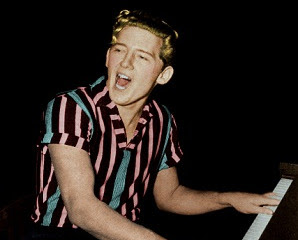
The Jerry Lee Lewis Paradox.

The Jerry Lee Lewis Paradox is simple: There is no legend bigger in rock & roll who has built their name on a smaller number of actual hits.

There were, officially, 5:

"Whole Lotta Shakin' Goin' On" (#3 Pop), 1957.
"Great Balls of Fire" (#2 Pop), 1957.
"Breathless" (#7 Pop), 1958.
"High School Confidential" (#21 Pop), 1958.
"What'd I Say" (#25 Pop), 1961.

Of those 5, only 4 fall within his crucial period of influence before his great fall: "Whole Lotta Shakin' Goin' On," "Great Balls of Fire," "Breathless," & "High School Confidential."

Of those 4, only 3 are actual rock & roll classics, as in, songs that get played on oldies radio: "Whole Lotta Shakin' Goin' On," "Great Balls of Fire," & "Breathless."

Of those 3, only 2 of the songs are actually considered top-notch rock & roll "great": "Whole Lotta Shakin' Goin' On" & "Great Balls of Fire."

The former is what no less of a source than John Lennon dubbed something that rock & roll has never improved upon; the latter is, for my money, the wildest rock & roll record of them all.

No small feat, to be sure, except for its, well, smallness.


* * *

But there is a second Jerry Lee Lewis Paradox that overlaps with the first: Perhaps no other artist has had such a small number of hits that have inversely yielded such a large number of greatest hits collections.

Ever since Jerry Lee Lewis had his (first?) comeback as a country star in the late '60s, there has been a steady stream of greatest-hits, best-ofs, boxed sets, rarities, retreads, & anthologies. Yet no one has sat down & made a definitive compilation that rivals the stone-cold compilation classics Elvis's Golden Records, Chuck Berry's The Great Twenty-Eight, Little Richard's Here's Little Richard, & Buddy Holly's The "Chirping" Crickets (OK, so those last two are "regular" albums, but they are made up almost entirely of hit singles & B-sides), although many have come close. A review:


The Original: Jerry Lee Lewis's Original Sun Greatest Hits, Vol. 1 & 2.

Counter-intiutive though it may seem, the first great Jerry Lee Lewis comp was only released to debunk an imposter. By 1968, Jerry Lee Lewis had finally found his way out of his decade in the desert, cashing in on a new sound on a new label. Rather then license Lewis's old Sun recordings (that wouldn't yield enough money—!), they simply had their star go ahead & record new versions of them, issuing them on an album (Jerry Lee Lewis's Golden Hits) that doubtless duped the majority who bought it into thinking that they were getting the real thing.

Sun Records quickly put out their own version — hence the unwieldy "Original" in the title — to stake their claim on the real thing. & for the most part, they get it right. Over the 8 of the 11 songs are the A & B-sides of his first four singles (that is, the first three listed above, plus one that came out before "Whole Lotta Shakin' Goin' On" — "Crazy Arms" — that was a local hit, but missed the national charts). The remaining three songs are a waste: a cover of Chuck Berry's "Little Queenie" that added nothing to the original, the non-hit "Teenage Letter," & "Lewis Boogie," a fine (& rare!) Lewis original that should've never been included over the somehow overlooked "High School Confidential."

Not surprisingly, this set the stage for a volume two, which picked up "High School Confidential" & its flip, "What I'd Say," & several near-hits: "Break-Up" (1958, #52 Pop), "I'll Make It All Up to You" (1958, #85 Pop), "I'll Sail My Ship Alone" (1959, #93 Pop), ("How's My Ex Treating You?," 1962, #98 Pop).  Filling out the rest are 3 covers: 1 classic ("Mean Woman Blues"), 1 near-classic ("Money"), & 1 not-very-remarkable classic ("How's My Ex Treating You?").  Put together with the first volume, it's a solid, if not amazing, collection.  The thing is, since it only runs 54 minutes, you can fit at least another half-dozen of worthy Sun-era contenders to the playlist, such as "Wild One," "Lovin' Up a Storm" (1959, #81 Pop), & "Let's Talk About Us" (1959, #76 Pop), the latter two of which are his only other charting singles of the 1950s.

Taken together as a two-fer (which is how they were reissued about a decade ago), I'd say 3.5/5 stars.


The Classic: 18 Original Sun Greatest Hits.

In the early 1980s, Rhino Records was evolving from a local label specializing in compilations into the premiere label for compilations. (Arguably international too, but that depends on how you feel about the German Bear Family label — the only label, by the way, to ever release an anthology of Jerry Lee Lewis's entire Sun Records output, on 8 CDs.) One of the discs they made their name on was this.

Long favored by the Rolling Stone Album Guide as the best single-disc collection of Lewis's music out there, it does its job remarkably well.  It was clearly compiled to include the hits, as evidenced by the opening sweep of "Whole Lotta Shakin' Goin' On," "Great Balls of Fire," "Breathless," "High School Confidential," & "What I'd Say" in an epic 5-song sweep.  The rest are a range of highlights from his debut album ("Matchbox," "Jambalaya," "When the Saints Go Marching In," "Ubangi Stomp," "Put Me Down"), fan favorites ("Lewis Boogie," "It'll Be Me," "Big Blon' Baby," "Crazy Arms," & "Wild One"), & some deep cuts ("Drinkin' Wine Spo-Dee-O-Dee," "All Night Long," & "Big-Legged Woman").  It's one of those successful comps in that as you're listening to it, you don't notice anything missing.

But there is: B-sides.  Aside from "It'll Be Me," none of Jerry Lee Lewis's classic singles have their B-sides to go with them.  Maybe they felt "You Win Again" & "Fools Like Me" were too country sounding — but not much more so than "Jambalaya" or "Crazy Arms" — but they really have no excuse for omitting "The End of the Road," "Down the Line," & perhaps even "Livin' Lovin' Wreck."

As such, it tells a great story, but only about half of it.

I'd give it 4.5/5 stars.


The Modern Classic: The Jerry Lee Lewis Anthology: All Killer, No Filler!

This has become the default Jerry Lee Lewis collection of the modern era. It made Rolling Stone's list of the 200 Essential Albums, then cropped up again a little over a decade later on its list of rock's 500 Greatest Albums, even though it had been long out of print. But as Jerry Lee Lewis comps go, it was a watershed: Assembled with love by Rhino Records, the album marked the 1st time that a collection held material from all of his various labels — Sun, Smash, & Mercury — spread over 2 discs of rock, country, blues, & pop.

If the most famous era of his work — the early rockabilly — got the thrift, that was the point. The entire Sun output is summarized in a dozen songs, but with the A & B sides of each of his first 4 singles, plus "High School Confidential," it held together deceptively well. Much more time was allotted for Lewis's country hits, which took up the remaining disc & a half. Because of the huge divide between rock & country, this was all pretty unfamiliar territory to the average rock fan, but it worked because Lewis was always a stylist first & a singer second, lending his voice & key-raking fingers to material as disparate as "Chantilly Lace" & "Over the Rainbow."

This would be the perfect set it feels like, if only it included Lewis's other two Top 40 hits — namely, the how-is-it-possible? MIA "What'd I Say" & the surprise hit country flip "Me & Bobby McGee" (1971, #40 Pop) — & his one other Top 10 country song, "Sometimes a Memory Just Ain't Enough." As for "McGee," its easy to understand because IT COMPLETELY SUCKS (where Joplin took a country song, sang it like blues, & made it pop, Lewis takes a country song, makes it a weird boogie shuffle, & is then joined by the nerdiest-sounding backing vocals ever heard outside of a novelty record), but one thinks they could've included it for completist's sake. "What'd I Say" & "Memory" are more mysterious — they are both solid in & of themselves, & with each disc running a little over 60 mins, there was more than enough room to include them.

This would be 5 stars — it feels like 5 stars — but given the rockabilly years given the thrift, I'm gonna make this one 4.5 out of 5 as well.


The Post-"Modern Classic" Classic: Jerry Lee Lewis: The Definitive Collection.

All told there is only one album that actually includes all of Jerry Lee Lewis's Top 40 hits: Hip-O Records' The Definitive Collection, which, in filling the hole left by Rhino's out-of-print classic, plays like The Jerry Lee Lewis Anthology Lite. Running at one disc & 24 songs, it is the only place where you can get every Top 40 hit: "Whole Lotta Shakin' Goin' On," "Great Balls of Fire," "Breathless," "High School Confidential," "What'd I Say," & "Me & Bobby McGee" (the first 5 of which are included in the album's first 6 songs; only "You Win Again" got added to the Sun period). The set also adds "Memory," as though just to jab Rhino's collection for overlooking it. But with only 24 songs, it can hold at least another 4, so I made my own playlist (yer welcome) that can be made using this disc as yer base & adding a few songs from the Rhino Anthology, since they're mastered at roughly equivalent volumes:

1. Crazy Arms*
2. Whole Lotta Shakoin' Goin' On
3. Great Balls of Fire
4. You Win Again
5. Breathless
6. High School Confidential
7. Break-Up*
8. What'd I Say
9. Another Place, Another Time
10. What's Made Milwaukee Famous
11. She Still Comes Around (To Love What's Left of Me)
12. To Make Love Sweeter for You
13. One Has My Name
14. Don't Let Me Cross Over
15. She Even Woke Me Up To Say Goodbye
16. One Minute Past Eternity*
17. Once More with Feeling
18. There Must Be More to Love Than This
19. Touching Home*
20. Me & Bobby McGee
21. Would You Take Another Chance on Me?
22. Chantilly Lace
23. Drinking Wine Spo-Dee-O-Dee
24. Sometimes a Memory Just Ain't Enough
25. He Can't Fill My Shoes
26. Middle Age Crazy
27. Over the Rainbow
28. Thirty-Nine & Holding

So 4 songs were added in total: "Crazy Arms," which has somehow been written out of Lewis's chronology these days — his 3-disc Half Century of Hits & 2-disc Gold both omit it, with the latter clearly trying to use "The End of the Road" in its place — & is the biggest overlook of the initial Definitive song list; "Break-Up" to grab one more Sun-era slot &, outside of "What'd I Say," the only other Top 50 hit he would ever have; "One Minute Past Eternity," which made it all the way to #2 Country; & "Touching Home," which made it to #3. With this playlist, you have all of Lewis's Top 40 Pop hits & Top 5 Country hits. (For the record, it is possible to fit all of Lewis's Top 10 Country hits — he had 28 — onto a single disc, but it doesn't tell the story as clearly).

I also corrected some screw-ups with chronology — mainly, "Another Place, Another Time" coming before "What Made Milwaukee Famous," a choice that made no sense at all. & finally, I replaced the version of "Drinking Wine Spo-Dee-O-Dee" with the classic version that was almost a Top 40 hit (1973, #41 Pop), because the original running order mysteriously used a different version from a decade earlier.

The original version: 4/5 Stars; my version with bonus tracks: 5/5 Stars.


* * *

Now I know what yer all thinking, "Hey man, you got really off-track here. I just want Jerry Lee Lewis the rocker, man, the rocker & none of that country junk."

Well, would you believe that I have been writing this whole article fer one reason & one reason only: To single-handedly petition the powers at Sun Records to release what I call...


My D.I.Y. Classic: Great Ball of Fire: The Original Sun Discography (1956-1959).

It turns out that Jerry Lee Lewis released so little (he recorded a ton more) that you can make it through his entire hit career & then some, with the only Top 40 hit lost "What'd I Say."  Check it:

Singles (1956-1957):
1. Crazy Arms
2. End of the Road
3. Whole Lotta Shakin' Goin' On
4. It'll Be Me [Single Version]
5. Great Balls of Fire
6. You Win Again.

The Great Ball of Fire EP (& source of this album's "cover") (1958):
7. Mean Woman Blues
8. I'm Feelin' Sorry
9. Turn Around

Singles (1958)
10. Breathless
11. Down the Line
12. High School Confidential
13. Fools Like Me

Jerry Lee Lewis LP (1958):
14. Don't Be Cruel
15. Goodnight Irene
16. It All Depends (On Who Will Buy the Wine)
17. Put Me Down
18. Ubangi Stomp
19. Jambalaya (On the Bayou)
20. When the Saints Go Marching In
21. Matchbox
22. It'll Be Me [LP Version]

Singles (1958-1959)
23. The Return of Jerry Lee
24. Lewis Boogie
25. Break-Up
26. I'll Make It All Up to You
27. I'll Sail My Ship Alone
28. It Hurts Me So
29. Lovin' Up a Storm
30. Big Blon' Baby

You get Lewis's first 9 singles, plus his first EP & LP, taking you from the original sound to the post-scandal oblivion.

& it all works because he has so few hits.

In fact, maybe it wasn't that he had so few hits as he had so little put out in the first place.

Putting it all together in this "Original Discography" comp is a very tempting solution — who knew that everything you could ever want — i.e., not just the best of his career, but the entire main arc of his career — could fit onto a single disc? I think I just out-paradoxed the paradox.

Well, probably the good folks at Sun Records know this, & fer want of selling records, have purposely never released it.

Although I think they really should.

Obviously.


[Ed. Note: If you dig this, check out a similar American Wolf post about Elvis: The Elvis Anthology Problem.]
Sunday, October 21, 2012

R.I.P. George McGovern, 1922-2012.


It's always struck me that, more than any modern Democratic standard-barer, there was an essential elusiveness about George McGovern; all paths that should seemingly lead to him in fact led to other places.

McGovern is most famous for running against Richard Nixon for president in the 1972 election, of which 3 things are almost always remembered:

1. He lost in one of the biggest landslides in history, losing every region but Massachusetts & the District of Columbia, for a grand total of 520 to 17 in the Electoral College.

2. His campaign was the victim of the infamous Watergate scandal & coverup, which subsequently brought down the administration that had beaten him by a record 18 million popular votes.

3. His campaign was covered by Hunter S. Thompson, whose journalism became the classic Fear & Loathing on the Campaign Trail '72.

The first two points are the biggies, for McGovern's loss in 1972 & Nixon's coverup of the Watergate scandal in 1974 stand as the twin peaks of American failure in the troubled 1970s.

Both have come to signify partisan extremism to the point of caricature: On one side, you had McGovern, the liberal's liberal — a populist pacifist who wanted to end the Vietnam War abroad & poverty at home — but was working with a Democratic Party that was so disorganized & inept, he could barely make a dent in the national map. On the other side, you had Nixon, the conservative's conservative — a cynic so paranoid & untrusting that he authorized the burglary of the Democratic headquarters of his opponent — all to help guarantee a victory in an election he was never going to lose. The fact that the Democrats ran McGovern in hindsight feels like a philosophical gesture rather than a tactical one, much like how the Republicans ran Barry Goldwater in 1964 (albeit on a directly opposite party platform).

The third point about Thompson's book is obviously the most superfluous one, except for this: As a nonfiction account of the 20th century American political scene from the inside, it's as gripping as Robert Warren Penn's All the King's Men is as a fiction account, which is to say it is the best. &, if we are to take Thompson at his word, it was he who began the rumors of early frontrunner Ed Muskie's alleged use of drugs, which opened the door for the dark horse McGovern to get the nomination.

All of which is well & good, but actively deflects away from George McGovern, the person. In the modern age of politics-as-the-cult-of-personality, McGovern feels like a final holdover from an earlier era where things didn't revolve around a 24-hour pop-culture theater.

Or, maybe it's all just a way of sidestepping the fact that George McGovern was not as straightforward as he seemed — his famous (some would say infamous) pacifism came from his experience as a World War II fighter pilot, where he flew more than 2 dozen missions over Europe in a B-24 & earned a Distinguished Flying Cross when he was struck by enemy fire & had to crash-land on an island in the Adriatic. This was a man who knew the horrors of war firsthand & wanted to prevent it from happening again — or, in the case of Vietnam, continuing to happen — to the nation's youth. For all the grief he's gotten over the years as an antiwar coward, he was one of the most distinguished soldiers to run on a major ticket in his era.

With this war & peace at his core, other contrasts begin to take shape. He was a Democrat from the traditionally Republican state of South Dakota, in which he all but single-handedly revived the Democratic party & eventually earned three terms as its senator. He was a history professor who eventually earned his Ph.D. at Northwestern University to become one of the few modern academics to seek major office, in the tradition of Jefferson, Wilson, & (perhaps) Kennedy. & he was an elderly statesman who kept eternally young, calling for Bush & Cheney's impeachment for the Iraq War in 2008 & staying active in political commentary until relatively recently.

I, for one, first seriously considered Barack Obama as a presidential candidate after reading McGovern's endorsement of him in a Rolling Stone interview. His endorsement was much like him at his best: Clear, level-headed, honest, & with integrity.

I got to see McGovern speak one time 4 years earlier, during the 2004 Democratic National Convention in Boston. He was giving a talk at the Old South Meeting House with former Governor Michael Dukakis, & I worked directly across the street at Borders. I was on cash register during the time of their talk, so I waited for the line to wane & ran across the street to catch what I could as though I had just stepped out for a quick break. (This was the kind of junk you could get away with working at Borders; is it any wonder that they are no longer in business?)

Dukakis went on & on, as he was prone to do, but when it (finally) came to McGovern's turn, his words were every bit measured & refined as Dukakis's were rambling & chattery. McGovern was the picture of an elderly statesman, & he spoke softly but clearly, with nothing less than grace:

"Last night at the Democratic National Convention, I saw 3 men give the speeches of their careers. First, was Al Gore. Now, where was that fighting spirit 4 years ago?! & next, was Jimmy Carter—"

I began clapping almost instinctually, such that McGovern looked up a bit startled, but not at all upset, as I led the room in applause. He gave us a second, & continued where he left off.

"—next was Jimmy Carter. That man gets better & better every day, doesn't he? & then finally Bill Clinton, who is always at his peak."

His words were wistful & charming as they retold the narrative of the modern Democratic party, leading up to John Kerry, who, in what I can only describe as the misty-eyed nostalgia of 2004, looked as though he could — & would — become our next president.

In other words, my own personal memory of McGovern leads everywhere but to him.

Thursday, October 4, 2012

Denver Debate 2012: W.T.F. (Where's The 47%)?!

There had been some conventional wisdom I'd held onto about the 2012 debates from the moment that Mitt Romney selected Paul Ryan as his running mate: Don't let Joe Biden get cocky.  Say what you will about his policies (& there's a lot to be said), but as a public speaker Paul Ryan can be very effective — neat, concise, & persuasive.  Even when he's telling flat-out lies.  (Or perhaps, especially when he's telling flat-out lies.)  It was easy to picture a scenario where Biden — who was elected as a senator when Paul Ryan was in diapers, literally — thought he had it in the bag, under-prepped & underwhelmed in some mix of hyperbole & impulsiveness, while Ryan, cool, coherent, & collected, proved his worth as the GOP's "idea man."  & for sure, such a scenario could still happen.

But after watching the debates last night, it struck me that maybe my "conventional wisdom" was misdirected — maybe it was President Obama who needed to be sure not to get cocky.

It seemed to explain Obama's all but universally-panned performance last night, seeming meek, listless, & unfocused, while Mitt Romney more than held his own, heightened by a very strong start & a solid close.  In the middle, he seemed (to me, anyway) to get a bit rude & fiery, & the fact-checkers are all earning overtime deconstructing what he said.  But in the greater modern political narrative, how things are said is often more important than what things are said.  Just ask LBJ who, after listening to the televised Kennedy-Nixon debates over the radio, declared Nixon the winner.

Political analyst (& former Reagan & Clinton advisor) David Gergen wrote earlier this week that in order to — let's just say it — save his campaign, Romney could not merely hold his own against the president, Romney had to decisively out-debate him.  & indeed, moments after the debates ended, an astonished Gergen proclaimed that, against all odds, this is exactly what Romney did. Somehow, it was Romney who came off as more poised, confident, & clear; it was Romney who better connected things to "average people" & the rest.  In other words, it was Romney who did all the things that President Obama is usually masterful at.

& that doesn't even begin to hint at the litany of things that Obama could've (& should've) hit Romney with, from his tenure at Bain (which Obama successfully defused just as Bush had done with Kerry's war record) to his term as governor (during which Massachusetts was 47th out of job growth, & only then because Hurricane Katrina caused Louisiana to bump it up from 48th) to Romney's numerous gaffes such as when he attacked the president's handing of the recent Middle East crisis before he had all of the information at hand.

& then, of course, there's the biggie, which came from Romney's OWN MOUTH: Namely, that Romney doesn't need to worry about the 47% of Americans who are dependent victims living off of the government.  As moderator Jim Lerher asked again & again for differences in their philosophies, Obama didn't mention that, um, he cared about 100% of the Americans, not 47% of them.

So, the question becomes, WHAT THE F___ HAPPENED?  I've read everything from Obama simply choked to that he was strategically actually laying low & keeping calm to size up his competition in preparation for pouncing in the next debate.  (Um, OK.) But it was CNN's analyst (& magical map master) John King's theory that resonates the truest with me: It seemed that, with his lead in the past few weeks (make that months), Obama went into the debate trying to keep "above the fray" such that he didn't want to lower himself to get in the muck of what could be considered partisan mudslinging — the Bain tenure, the Middle East criticism, the 47%, etc.

That's all well & good in theory, but do you know who else tried to stay "above the fray"?  John Kerry, who refused to bite back at the Republican "swiftboat" campaign, & look at the results: Bush got became a 2-term president, Kerry became a historical footnote, & swiftboating became a verb.

Is it merely a coincidence, then, that the person who most helped Obama prep for last night's debate was none other than...JOHN KERRY???

All of which is to say, nothing irrevocable has really happened.  It's worthy to note that both Reagan & Bush decisively lost their first midterm campaign debate, although Reagan had the "excuse-in-retrospect" of showing early signs of Alzheimer's disease while Bush was not yet given an earpiece to help guide his answers.

But Obama?  It is perhaps, as one of my favorite journalists, Time Magazine's Joe Klein (who is rarely critical of major Democrats) called it, one of the most inept performances he's ever seen of a sitting president.

Maybe so, but I still remain optimistic as for what's to come.  If anyone can hunker down & study up to present themselves strongly, it's Barack Obama. Hopefully this first debate served as a wake-up call that the state of the union is still too fragile & Mitt Romney is far too capable for Obama to think he can just take the debates on an easy walk.

If I know President Obama, he will only go up from here, especially when you consider that one of the debates ahead focuses on foreign policy, his ace card in the eyes of voters.

Maybe in the meantime, my conventional wisdom will turn itself on its head & it will be Joe Biden who has to remind Barack Obama not to get too cocky.